Omega Seamaster: History, Deep Dive and Latest Models


The Omega Seamaster: A Legacy Built in Water
Few watches carry as much history on their wrists as the Omega Seamaster. Launched in 1948 to mark Omega's centenary, it was conceived as a water-resistant tool watch that could serve both military and civilian divers. Over the decades it evolved from a relatively modest dress watch with enhanced water resistance into one of the most technically sophisticated dive watch families in Swiss horology. Today, the Omega Seamaster collection spans everything from elegant Aqua Terra dress watches to the formidable Ploprof rated to 1,200 metres.
That is quite a range. And navigating it can feel overwhelming, especially with well over sixty Seamaster variants available at any one time. This guide cuts through the complexity, covering the collection's history, its key sub-families, and the specific models we think are worth your attention in 2026.
A Brief History of the Seamaster
1948 to the 1960s: The Founding Generation
The original Seamaster was a rather elegant piece by contemporary standards. It wore a cushion-shaped case and offered water resistance of around 60 metres, which was genuinely impressive for the era. Omega supplied versions to the Royal Navy and other armed forces, cementing the watch's practical credentials early on. Throughout the 1950s and into the 1960s, Seamaster cases became more refined, movements more accurate, and water resistance ratings climbed steadily.
The Seamaster 300, introduced in 1957, was a decisive step forward. Rated to 300 metres, it featured a rotating bezel, a bold lollipop seconds hand, and a level of legibility that made it a genuine professional diving instrument. This was the watch that divers and military frogmen actually trusted underwater.
1970s to 1980s: The Quartz Disruption
Like virtually every Swiss manufacturer, Omega felt the full force of the quartz crisis during the 1970s. Seamaster production continued, but the collection's identity became somewhat diluted as Omega experimented with quartz movements and different case formats. Some of the more imaginative designs from this period have since attracted collector interest, but these are generally not the years Seamaster historians point to with the most enthusiasm.
1993: The James Bond Moment
The Seamaster's modern identity was arguably forged in 1993, when the Seamaster Professional 300m appeared on Pierce Brosnan's wrist in GoldenEye. The association with the 007 franchise gave the watch a cultural status that extended far beyond the diving community. It became a recognisable symbol of sophisticated adventure, and sales reflected that. Omega has maintained the Bond connection ever since, with special edition models released alongside each film in the franchise.
Today, the legacy of that partnership lives on in dedicated limited editions. The Omega Seamaster Diver 300M James Bond 007 60th Anniversary, available from £7,900, is a compelling example. It wears the 42mm case format that has defined the modern Diver 300m, with calibre-level detailing that pays tribute to six decades of the franchise.
Co-Axial Era and Master Chronometer: 2000s to Present
Omega's development of the Co-Axial escapement, commercially introduced in 1999, fundamentally changed the brand's mechanical proposition. Unlike the traditional lever escapement found across most Swiss watches, the Co-Axial design reduces friction at the escapement wheel, resulting in longer service intervals and improved long-term rate stability. The Seamaster was one of the first families to benefit from this technology, and the step change in movement quality was real.
The next significant leap came with the introduction of Master Chronometer certification, developed in partnership with METAS (the Swiss Federal Institute of Metrology). Master Chronometer watches are tested to a standard considerably more demanding than standard COSC chronometer certification. They must maintain accuracy of 0 to +5 seconds per day across a variety of positions and temperatures, and they must function correctly in magnetic fields of up to 15,000 gauss. For context, an un-shielded conventional movement may be disrupted by fields as low as 60 gauss. This matters in practice, particularly if you work near electronic equipment or MRI machines.
The Seamaster Sub-Families Explained
Seamaster Diver 300m
This is the heartbeat of the collection. The Diver 300m is the watch most people picture when they think of the Seamaster. The current generation wears a 42mm stainless steel case, features a wave-pattern dial in various colourways, and is powered by the Calibre 8800 or 8900 Co-Axial Master Chronometer movement. The helium escape valve sits at 10 o'clock, the unidirectional rotating ceramic bezel locks with reassuring precision, and the bracelet or rubber strap options both carry the watch convincingly.
Water resistance is rated to 300 metres, which is substantially more than most wearers will ever need but provides a meaningful margin of safety for regular recreational diving. The movement delivers a power reserve of approximately 55 hours and is certified to the full Master Chronometer standard.
Entry into the steel Diver 300m range starts from £5,300, with Co-Axial Master Chronometer variants available from the same price point. Chronograph versions and special editions command higher premiums.
Seamaster Aqua Terra
The Aqua Terra occupies a different space. Less aggressively sporty than the Diver 300m, it is better understood as a refined sport watch that happens to carry 150 metres of water resistance. The distinctive teak-pattern dial, named for the vertical lines that reference teak wood decking on sailing yachts, gives the watch a quietly distinctive identity. It wears well with both casual and business dress.
The Aqua Terra is available in case sizes from 30mm to 41mm, making it one of the more size-inclusive references in the Seamaster line. The Seamaster Aqua Terra 150M 38mm Co-Axial Master Chronometer, from £5,700, represents a particularly well-balanced choice for those who want the full Master Chronometer specification in a case that suits a broad range of wrist sizes.
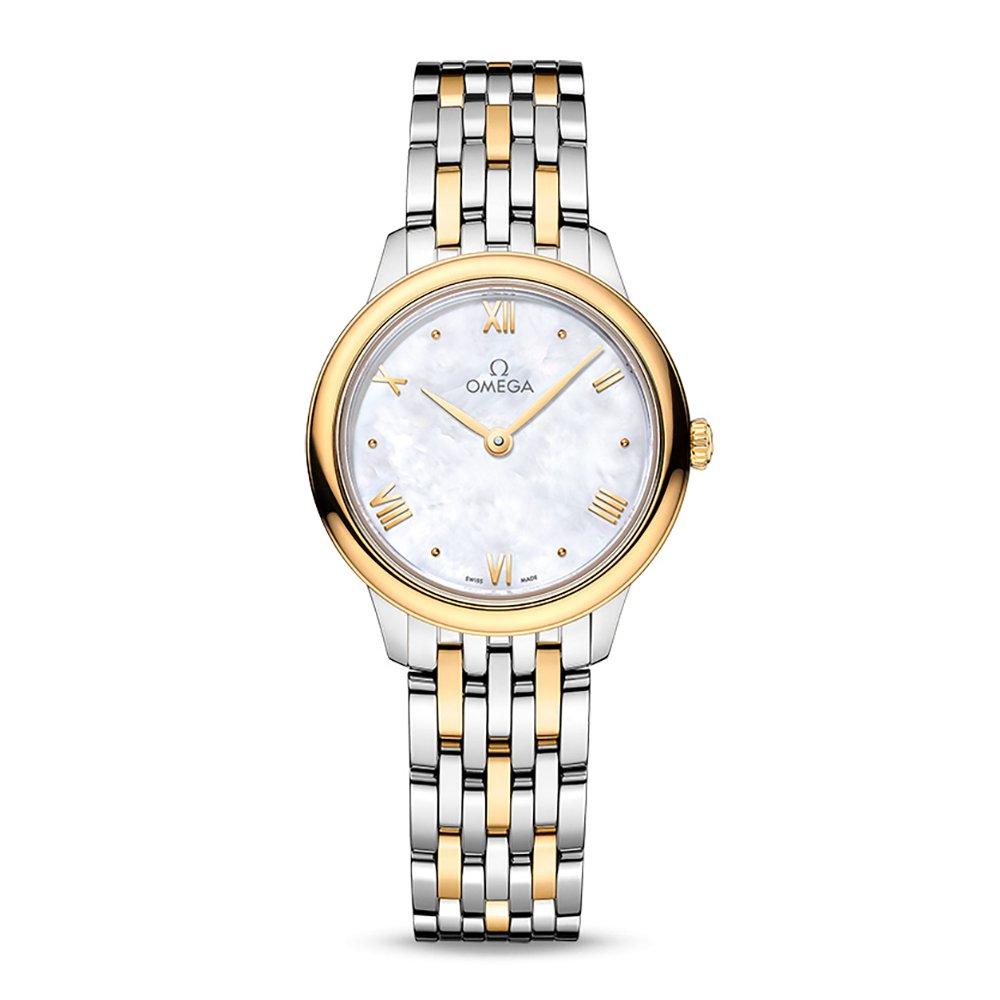
For those wanting something a little more compact or with gemstone embellishment, the Aqua Terra range extends downward to include diamond-set ladies' variants, with the Seamaster Aqua Terra Diamond Ladies Watch available from £3,100.
Seamaster Planet Ocean
The Planet Ocean pushes the performance envelope further. Rated to 600 metres, it wears a larger, more architecturally assertive case than the Diver 300m and uses sapphire crystal with anti-reflective treatment on both sides. The helium escape valve is standard, and the movement specification meets Master Chronometer requirements. The Planet Ocean 600m Co-Axial Master Chronometer is available from £7,700 in steel, with chronograph variants adding further complexity.
Seamaster Ploprof 1200m
For completeness, the Ploprof (short for Plongeur Professionnel) sits at the extreme end of the Seamaster's performance spectrum. Rated to 1,200 metres, it features an unusual asymmetric case with a distinctive orange button that locks the bezel against accidental rotation. It is genuinely purpose-built for saturation diving. The Seamaster Ploprof 1200m is available from £13,500. A serious watch for serious depths.
Key Specifications at a Glance
| Model | Case Size | Water Resistance | Movement | Price From |
|---|---|---|---|---|
| Seamaster Diver 300m Automatic | 42mm | 300m | Co-Axial Automatic | £5,300 |
| Seamaster Aqua Terra 150M 41mm | 41mm | 150m | Co-Axial Master Chronometer | £6,000 |
| Seamaster Planet Ocean 600M 42mm | 42mm | 600m | Co-Axial Master Chronometer | £7,700 |
| Seamaster Diver 300m Chronograph | 44mm | 300m | Co-Axial Automatic Chronograph | £7,700 |
| Seamaster Ploprof 1200m | 55mm | 1,200m | Co-Axial Chronometer | £13,500 |
Best Value Picks in the Seamaster Range
Under £6,000: The Diver 300m Entry Point
The steel Diver 300m variants starting from £5,300 represent exceptional value for a Swiss Co-Axial movement with Master Chronometer certification, 300 metres of water resistance, and a ceramic bezel that resists fading or scratching. No other material degrades more gracefully than ceramic in this context. You are getting a great deal of horological capability for the money.
The Aqua Terra at the 38mm size, from £5,700, is our preferred recommendation for those who find 42mm cases slightly large. The proportions suit a greater range of wrists without sacrificing any of the technical specification.
£6,000 to £8,000: The Core Performer Range
This price bracket contains some of the most compelling Seamaster options. The Aqua Terra 150M 41mm with full Master Chronometer certification, the Planet Ocean 600M in its standard steel form, and the Diver 300m Chronograph all sit here. If we had to pick one, the Planet Ocean 600M Co-Axial Master Chronometer at £7,700 stands out for its combination of depth rating, movement quality, and case presence.
£7,900 and Above: Special Editions and Precious Metals
Beyond £7,900, the Seamaster range takes in the Bond special editions, titanium variants, bronze-gold Titanium models, and precious metal references. The Seamaster Diver 300m in 18ct Sedna Gold, from £8,100, combines Omega's proprietary warm-toned gold alloy with the full Diver 300m technical specification. Sedna Gold is notably resistant to fading compared with conventional red gold, which makes it a more practical choice in a watch that sees real use.
The titanium variants, starting around £5,800 for Co-Axial Master Chronometer specification, are worth particular attention for those who prioritise comfort on the wrist. Titanium cases weigh roughly 40% less than equivalent steel constructions, which makes a genuine difference over a full day's wear.
Dial Choices and Personalisation
One of the Seamaster's strengths is the breadth of dial options available. The Diver 300m alone is offered in blue, green, black, grey, and several other colourways, with both glossy and more technical-looking textures. The wave-pattern texture is a constant across the Diver 300m range and contributes meaningfully to the dial's depth and visual interest under different lighting conditions.

The Aqua Terra's teak pattern dials are equally well executed. Omega has introduced "Shades" versions of the Aqua Terra in recent seasons, featuring gradient dials that shift in tone across the surface. These are among the most visually arresting dials in the range and are available in both steel and two-tone steel-and-gold combinations.
Strap and Bracelet Options
Most Seamaster references are supplied on either a stainless steel bracelet with Omega's micro-adjust folding clasp, or a rubber strap with a signed buckle. The rubber option is more practical for actual water use and handles perspiration better during warmer months. Omega's quick-release spring bars, fitted to many current Seamaster references, make strap changes a matter of seconds without tools.
Leather strap options are available on certain Aqua Terra variants, and these dress the watch up considerably. For everyday wear, the steel bracelet is our preference. It is well-finished, comfortable at the correct length, and wears the watch at the intended case height.
Should You Buy New or Pre-Owned?
The Seamaster holds its value well by the standards of the broader watch market, though it does not typically appreciate in value like certain limited-edition models from other parts of Omega's catalogue. Buying new from an authorised retailer gives you the full five-year Omega warranty and the confidence of a genuine service record from new. Buying pre-owned can represent a meaningful saving on retail, but verification of authenticity and service history is essential.
At WatchShopper, we list Seamaster models from authorised UK retailers, so you can compare verified prices across sources in one place. All prices quoted here are live figures from our retailer network and reflect current UK market rates.
Our Verdict
The Omega Seamaster is not a single watch. It is a family of precision instruments that spans genteel sport to professional saturation diving, tied together by consistent movement quality and a design language that has proven remarkably durable over nearly eight decades. The Co-Axial Master Chronometer specification sets a genuine technical benchmark, and the breadth of case sizes, dial options, and price points means there is almost certainly a Seamaster suited to any brief.
For most buyers, the Diver 300m in steel represents the definitive Seamaster. It is the model with the clearest identity, the strongest heritage, and the most immediate visual appeal. Start there, and work outward from the core.
*prices in the price cards update daily; prices mentioned in the text were correct at the time of writing