Arnold and Son: History, Heritage and the Complete Watch Range



A Name Rooted in Horological History
Few watch brands can trace their lineage as directly to the very foundations of precision timekeeping as Arnold and Son. The story begins with John Arnold, born in Cornwall in 1736, who became one of the most significant horologists of the 18th century. His contributions to the development of the marine chronometer were not merely incremental improvements. They were defining moments in the history of navigation and scientific measurement.
Arnold developed the helical hairspring, refined the detent escapement, and produced portable chronometers at a scale and consistency that no maker had achieved before him. His work earned him the respect of the British Admiralty and the admiration of fellow horologists across Europe. When his son, John Roger Arnold, joined him in the business, the name Arnold and Son was formalised, cementing a father-and-son partnership that left a permanent mark on the craft.
The modern brand draws directly on this heritage. Re-established in the 1990s and now part of the Citizen Group, Arnold and Son operates out of La Chaux-de-Fonds in Switzerland, producing entirely in-house movements with a philosophical commitment to the values the original Arnold established: accuracy, finishing, and technical integrity. This is not a brand that trades on history alone. Every watch in the current range is built to reflect what the name has always stood for.
What Makes Arnold and Son Distinctive?
The defining characteristic of an Arnold and Son watch is the movement. The brand develops and manufactures its own calibres, which is a significant distinction in an era when many luxury houses rely on third-party ebauches. The finishing standards are exceptional, with bridges and plates decorated to levels you would expect from far more expensive independent makers.
Skeleton and open-worked dials appear frequently across the range. This is a deliberate choice. Arnold and Son uses the dial as a window into the movement, allowing the wearer to observe the mechanical architecture directly. The brand's designers treat legibility and transparency as complementary rather than competing goals, a balance that is genuinely difficult to achieve and which gives the watches their distinctive visual identity.
Case sizes tend to sit at 41.5mm to 42.5mm, which places them comfortably in the contemporary preference for medium-large dress watches. The brand works across steel, titanium, red gold, and platinum, and has produced several limited edition pieces that have attracted serious collector attention.
The Current Range on WatchShopper
We currently list six Arnold and Son watches, spanning a considerable price range from around £15,700 up to £84,600. They fall naturally into three tiers: entry-level haute horlogerie, mid-range complication pieces, and rarefied limited editions.
Entry Point: The Nebula
The Nebula 41.5mm Steel in Blue is available from £15,700 and represents the most accessible way into the Arnold and Son collection. Do not let the word "accessible" mislead you. At this price, you are receiving a watch with a fully in-house movement, meticulous hand finishing, and a dial design that references the celestial themes the brand returns to repeatedly throughout its range.
The steel case at 41.5mm is a well-judged size. It wears comfortably on a variety of wrist sizes without feeling oversized for a dress context. The blue dial is striking without being ostentatious, and the open-worked sections reveal the movement in a way that rewards careful examination. For a collector looking to enter the brand, this is the logical starting point.
Mid-Range Complication: The Longitude Collection
The name Longitude carries obvious historical weight for Arnold and Son. John Arnold's work on marine chronometers was intrinsically linked to the problem of determining longitude at sea, one of the great scientific challenges of the 18th century. The brand's Longitude collection pays direct tribute to that legacy.
Two variants appear in our listings at this tier, both in titanium at 42.5mm and both priced from £21,400. Titanium is an interesting material choice here. It offers excellent strength-to-weight performance, making the watch noticeably lighter on the wrist than an equivalent steel case, which suits longer wear particularly well.
The slightly larger 42.5mm case gives the movement more visual space, which matters on a watch designed to be seen through the dial. The blue dial treatment on both variants connects the collection to the oceanic and navigational themes that run throughout Arnold and Son's design language.
| Watch | Case Material | Case Size | Price From |
|---|---|---|---|
| Nebula 41.5mm Steel Blue | Steel | 41.5mm | £15,700 |
| Chonometry Longitude Titanium 42.5mm Blue | Titanium | 42.5mm | £21,400 |
| Chronometry Longitude Titanium 42.5mm | Titanium | 42.5mm | £21,400 |
| Perpetual Moon 41.5mm Platinum Celestial Blue | Platinum | 41.5mm | £46,300 |
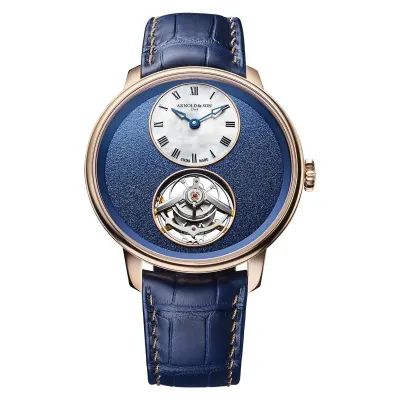
| Chronometry Ultrathin Tourbillon Red Gold 41.5mm Blue | Red Gold | 41.5mm | £72,900 |
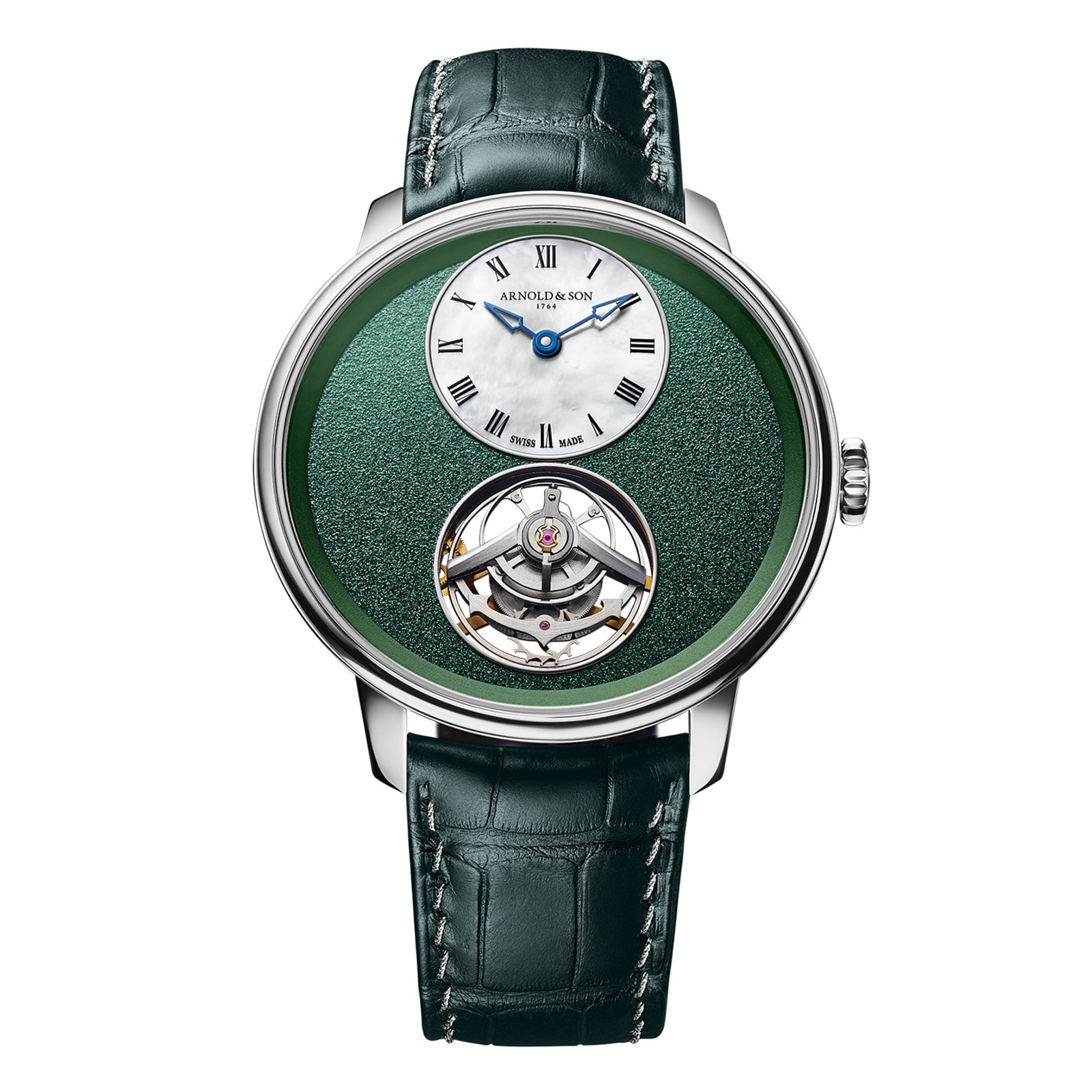
| Ultrathin Tourbillon Platinum 41.5mm Limited Edition Green | Platinum | 41.5mm | £84,600 |
Upper Tier: The Perpetual Moon
The Perpetual Moon 41.5mm in Platinum with the Celestial Blue dial is priced from £46,300 and is a limited edition piece of genuine horological substance. A perpetual moon phase complication is one of the more technically demanding additions to a wristwatch movement. When executed correctly, it displays the lunar cycle with an accuracy that requires minimal correction over many decades.
Arnold and Son's approach to the moon phase display is characteristically theatrical. The celestial blue dial is designed to evoke the night sky directly, with the moon phase aperture functioning almost as a porthole onto a miniature astronomical scene. In platinum, the case has a cool, dense presence that suits the seriousness of the complication. This is a watch for the collector who understands exactly what they are looking at.
Pinnacle Pieces: The Ultrathin Tourbillon Collection
The Ultrathin Tourbillon collection sits at the very top of the Arnold and Son range, and the two watches listed here represent the brand at its most technically ambitious. A tourbillon, for those unfamiliar with the complication, is a rotating cage that houses the escapement and balance wheel. Originally conceived by Abraham-Louis Breguet in the late 18th century, precisely the era in which John Arnold was working, the tourbillon was designed to counteract the effects of gravity on a pocket watch movement.
In a modern wristwatch, the tourbillon's practical contribution to accuracy is largely symbolic. What it demonstrates, however, is an uncompromising level of mechanical craftsmanship. Building a tourbillon that is also housed within an ultrathin movement is significantly more demanding than simply adding one to a standard calibre. The engineering constraints are severe, and the finishing requirements are unforgiving.
The Chronometry Ultrathin Tourbillon in red gold with a blue dial is available from £72,900. Red gold gives the case warmth and visual contrast against the blue dial, and the open-worked movement visible through the dial is simply one of the finest sights in contemporary watchmaking at this price tier.
The Ultrathin Tourbillon Platinum Limited Edition in green is priced from £84,600 and is the most exclusive piece in our current listings. The green dial is an unusual choice for Arnold and Son, and it works. The platinum case and the rarity of the edition make this a watch that collectors will recognise immediately as something out of the ordinary.
Arnold and Son Movement Philosophy
It is worth stepping back to consider what in-house manufacture actually means in this context. Arnold and Son employs its own watchmakers, engineers, and dial designers at its La Chaux-de-Fonds facility. Every movement is conceived, developed, and produced there. This gives the brand complete control over quality, finishing, and technical specification.
The calibres used across the range vary in complexity, but all share certain characteristics: generous power reserves, high-quality finishing on visible components, and a design language that prioritises visual appeal as well as mechanical performance. The UTTE (Ultrathin Tourbillon with Escapement) calibre used in the tourbillon pieces is particularly notable for achieving both thinness and mechanical complexity simultaneously.
Power reserves across the range are generally substantial. Many Arnold and Son calibres offer 90 hours or more, which is significantly above the industry standard of 40 to 48 hours. For a watch you might wear three or four days a week rather than every day, this matters practically.
Who Is Arnold and Son For?
These are not watches for casual buyers. The entry price of £15,700 places the brand firmly in the upper tier of accessible luxury. The target audience is the informed collector who has moved beyond well-known entry-level Swiss brands and is looking for something with genuine technical substance and a meaningful heritage narrative.
The historical connection to John Arnold is not marketing invention. It is a documented and significant chapter in the history of horology. For a collector who appreciates that context, wearing an Arnold and Son watch carries a weight that purely contemporary brands cannot replicate.
The range also rewards close inspection. These are watches that look better in person than in photographs, which is itself a positive signal about quality. The movement finishing, the depth of the dials, and the quality of the cases all reveal more detail as you examine them closely.
Best Value in the Range
Our pick for best value is the Nebula in steel. At £15,700 it is by some distance the most accessible watch in the Arnold and Son lineup, and it delivers the brand's core qualities without compromise. The in-house movement, the quality of finishing, and the visual drama of the dial all represent exceptional value at this tier of the market.
For collectors with a larger budget who want a complication, the Longitude titanium pieces at £21,400 make a strong case for themselves. The titanium case is a genuinely practical benefit, the movement is beautifully finished, and the historical resonance of the Longitude name gives the watch a narrative depth that adds to the ownership experience.
Summary
Arnold and Son occupies a distinctive position: a brand with authentic 18th-century roots, producing entirely in-house Swiss movements to the highest standards, at prices that remain below the stratospheric levels of the most established prestige names. The range is deliberately focused rather than sprawling, which means every watch in the collection is a considered statement rather than a range-filler.
From the Nebula at £15,700 to the Ultrathin Tourbillon Limited Edition at £84,600, there is a clear thread of values running through the entire collection. Technical ambition, visual coherence, and genuine horological heritage. That is a combination that is harder to find than it should be.
*article prices correct at the time of writing but can vary as we update each day


