Seiko Prospex Deep Dive: The Complete Buying Guide



Why the Seiko Prospex Range Deserves Your Attention
Few watch ranges in the world offer the breadth, history, and sheer horological credibility of the Seiko Prospex collection. Born from Seiko's first diver in 1965, the Prospex lineup now spans automatic and solar movements, compact 40mm cases and hulking 45mm shells, affordable entry points under £400 and serious collector pieces beyond £3,000. There is genuinely something here for everyone, from the curious newcomer to the dedicated enthusiast who has already owned half a dozen dive watches.
The name Prospex stands for Professional Specifications. That is not marketing speak. These watches are built to rated water resistances of 200m as a minimum, and many go considerably deeper. The finishing is serious. The movements are reliable. And the design language, drawing on decades of Seiko diving heritage, is unlike anything else on the market at these prices.
We have put together this guide to help you find the right Prospex for your wrist, your budget, and your intentions, whether that is actual underwater use or simply owning a tool watch with real pedigree.
Understanding the Prospex Family: Turtles, Samurai, Alpinists and More
The Prospex collection is organised around a handful of distinct case shapes and design lineages. Understanding these is the first step to narrowing down your choice.
The Turtle
The Turtle is named for the distinctive cushion-shaped case that echoes the original 1975 professional diver. It is one of the most recognisable Seiko case shapes in existence, with its rounded lugs, broad bezel, and substantial presence on the wrist. Most Turtles run on the 4R36 automatic movement and sit at 44mm or 45mm, which makes them a bold choice. They are rated to 200m water resistance as standard.
The Samurai
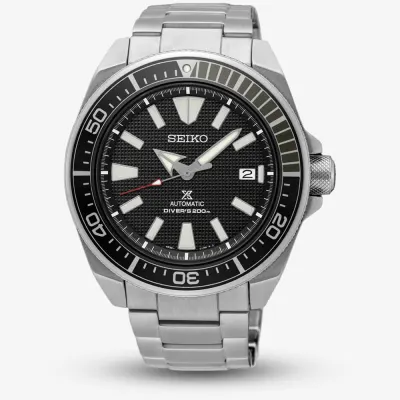
The Samurai takes a more angular approach. Its sharp, angular case is inspired by traditional Japanese sword design and gives it a more aggressive look than the Turtle. The Samurai is broadly the same size but feels more contemporary and less retro. It appeals to wearers who want a dive watch that reads as modern rather than nostalgic.
The Alpinist
Do not be misled by the name. The Alpinist is a diver at heart, rated to 200m, but its dial design, with a compass bezel and a more refined, symmetrical layout, makes it as comfortable in a business-casual setting as it is on a mountain trail. The Alpinist occupies the more elevated price tier within Prospex and uses the in-house 6R35 movement, offering a 70-hour power reserve.
The Speedtimer
The Speedtimer is Seiko's chronograph arm within the Prospex family, drawing on the 1969 "Pogue" reference worn by astronaut William Pogue on the Skylab mission. These are sport chronographs rather than dive watches, but they share the Prospex DNA: purposeful, robust construction, solar or mechanical movements, and a strong vintage-inspired aesthetic.
The Marinemaster
At the top of the range sits the Marinemaster. These are the watches Seiko makes when cost is not the primary concern. Built to 300m water resistance, finished to a noticeably higher standard than the rest of the range, and using movements produced in Seiko's most accomplished workshops, the Marinemaster commands prices that start well into four figures.
Prospex by Price: Where to Start Your Search
Under £500: The Entry Point
This is where the Prospex story begins for most buyers. The automatic Turtle variants represent extraordinary value at this level. The Seiko Prospex Turtle SRPE93K1 comes in from £343.95 and delivers the full Turtle experience: cushion case, 4R-series automatic movement, 200m water resistance, and a unidirectional rotating bezel. It is a proper dive watch at a price that would embarrass most of the competition.
The Samurai is also well represented here. The Seiko Prospex Samurai SRPF03K1 is available from £430.00, bringing that sharp, angular aesthetic at a very accessible price. For those drawn to solar power rather than an automatic movement, the Prospex solar divers enter the range from £470.00, offering perpetual convenience without ever needing a battery change.
There is also the Seiko Prospex Sumo SPB101J1, available from £546.00. The Sumo uses the superior 6R35 movement with that 70-hour power reserve, and the broader, domed case gives it a distinctly different personality to the Turtle or Samurai. It is a watch that rewards a closer look.
£500 to £800: The Sweet Spot
This is, in our opinion, where the Prospex range really hits its stride. The Alpinist models live here. The Seiko Prospex Alpinist SPB155J1 in green is available from £670.00 and is one of the most complete watches Seiko makes at any price. The compass inner bezel, the exquisite lacquered dial, the 6R35 movement with 70-hour power reserve, and the 200m water resistance combine to create something that transcends the typical dive watch brief.
The Speedtimer also enters the frame at this level. Solar chronograph variants such as the Prospex Crystal Blue Speedtimer SSC935P1 come in from £660.00. These are bold, sporty pieces that wear the Speedtimer's aviation and motorsport heritage proudly on their textured dials.
The 1965 Heritage Diver range also starts to appear here, with pieces priced from around £1,050.00 that offer a more faithful recreation of Seiko's original 1965 diver. These are slimmer, more elegant than the Turtle, and carry a level of finishing that justifies their position at the upper end of this bracket.
| Model | Type | Case Size | Movement | Water Resistance | Price |
|---|---|---|---|---|---|
| Prospex Turtle SRPE93K1 | Automatic Diver | 44mm | 4R36 | 200m | from £343.95 |
| Prospex Samurai SRPF03K1 | Automatic Diver | 43.8mm | 4R35 | 200m | from £430.00 |
| Prospex Sumo SPB101J1 | Automatic Diver | 45mm | 6R35 | 200m | from £546.00 |
| Prospex Alpinist SPB155J1 | Automatic Diver | 38.5mm | 6R35 | 200m | from £670.00 |
| Prospex Speedtimer SSC935P1 | Solar Chronograph | 41.5mm | Solar V192 | 100m | from £660.00 |
£800 to £1,500: The Collector's Tier
Once you cross the £800 mark, the Prospex range becomes noticeably more refined. The Alpinist variants here, such as the SPB505J1 Summit Black from £880.00 and the SPB507J1 Classic Pine Green from £800.00, introduce higher-grade finishing, sapphire crystals ground to exacting standards, and movements regulated to tighter tolerances.
The 1965 Heritage Diver series dominates this bracket. These 40mm recreations of the original 1965 Seiko diver are slimmer on the wrist, more elegant in profile, and carry finishing that approaches what you might expect from a Swiss manufacturer charging significantly more. The PADI special editions in particular, with their vivid colour treatments and co-branded bezels, have become genuinely sought-after pieces.
The Speedtimer 6R mechanical chronographs also appear here, from £850.00, offering in-house column wheel chronograph movements in a sport case. A mechanical chronograph from Seiko at this price point is a compelling proposition by any measure.
Above £1,500: The Marinemaster and Heritage GMT
This is rarefied territory for a brand that started its dive watch story under £350. The Marinemaster models, from £2,580.00, are built to a fundamentally different standard. The case finishing alone distinguishes them from anything lower in the range, with alternating brushed and polished surfaces executed with real precision. Water resistance steps up to 300m. The movements are regulated to COSC-adjacent levels of accuracy.
The 1968 Heritage Diver GMT models, priced from £1,400.00, deserve special mention. These recreate the aesthetic of Seiko's 1968 professional diver while adding a GMT complication, giving the wearer a second time zone function on a 42mm case with 200m water resistance. The finishing sits comfortably above anything in the mid-range, and the execution of the GMT hand and 24-hour bezel is thoughtful rather than perfunctory.
At the very top sits the Marinemaster JAMSTEC limited edition, priced from £3,550.00. Created in collaboration with the Japan Agency for Marine-Earth Science and Technology, this is a genuine statement piece. Numbers are strictly limited. Demand exceeds supply. These are watches that collectors hold onto.
Movements: What Powers the Prospex Range
Understanding the movement tiers helps set realistic accuracy expectations and informs your decision at each price point.
- 4R35 / 4R36: The workhorses of the entry-level Prospex range. Hand-winding and hacking (stopping the seconds hand to set the time precisely) are both supported. Accuracy is rated at plus or minus 15 seconds per day, which is honest rather than impressive.
- 6R35: A step up in every respect. The 70-hour power reserve is genuinely useful. Accuracy improves to plus or minus 10 seconds per day. This movement appears in the Sumo, the Alpinist, and selected 1965 Heritage models.
- Solar V-series: Powers the solar divers and Speedtimer solar chronographs. Accuracy is typically plus or minus 15 seconds per month, which is substantially better than any mechanical movement in the range. No winding required; simply expose the dial to light.
- 8L35 / 8L55: Reserved for Marinemaster-tier pieces, these are movements produced to the highest standards within Seiko's manufacturing ecosystem. Finishing is exceptional, and regulation is tighter than anything found lower in the range.
Which Prospex Should You Actually Buy?
For a first dive watch with genuine credentials, the Turtle is the obvious answer. It is the most recognisable Prospex shape, the most historically resonant, and the best value at its price point. Buy the SRPE93K1, put it on a rubber strap, and wear it with confidence.
For something more versatile, something that works as well with a shirt and trousers as it does on the water, the Alpinist is our recommendation without hesitation. The green dial SPB155J1 is one of those watches that looks better in person than it does in any photograph. That is not a common thing to be able to say.
For the chronograph enthusiast, the Speedtimer solar models offer a package that is hard to fault. Solar convenience, a proven movement, and a design that pays genuine tribute to the 1969 original make these among the more characterful pieces in the entire Prospex family.
For serious collectors or those buying a watch they intend to keep for decades, the 1965 Heritage Diver models represent the pinnacle of accessible Seiko craftsmanship. The step up in dial quality, case finishing, and overall execution is immediately apparent, and these pieces carry genuine historical weight.
A Note on Limited Editions
The Prospex range generates a substantial number of limited editions each year, including PADI collaborations, Save the Ocean pieces, and anniversary editions marking milestones in Seiko's diving history. These are worth tracking. PADI editions in particular tend to retain their appeal with collectors and often carry subtle design details, such as PADI's distinctive colour palette on the bezel and dial, that distinguish them clearly from standard variants. The 60th Anniversary PADI editions currently in the range are notable examples, priced from £600.00 and offering a level of finish and provenance that justifies the modest premium over standard models.
Final Thoughts
The Prospex range is one of the most coherent collections in the watch industry. Every piece, from the entry-level Turtle to the Marinemaster JAMSTEC, shares a clear design philosophy and a commitment to genuine tool-watch functionality. Prices span a huge range, but the value at each tier is consistently strong.
Whether your budget is £350 or £3,500, there is a Prospex built for you. Browse the full collection to compare prices across all current models and find the one that fits your wrist and your wallet.
*prices in the price cards update daily; prices mentioned in the text were correct at the time of writing